

 nubes

Builders bankruptcy add to Mexico's social housing failed policies
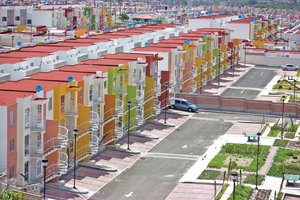
Social housing is now covered by companies that were considered middle-size before the crisis, such as Casa Javer and Consorcio ARA. (Photo: ARCHIVE / EL UNIVERSAL )
The bankruptcy filing of Casas Geo marks
the end of an era in the long list of government programs for social housing.
Geo was the poster child of the boom
experienced by building companies since the late 90's that lasted 10 years,
until the cost of building houses in the outskirts of cities was greater than
the revenue obtained. This is why the government decided to change its rules in
order to stop the sprawl.
According to the Mexican Institute
for Competitiveness (IMCO), from 2003 and until 2010, the National Housing Fund
Institute (Infonavit) gave over 3.2 million loans, more than the loans granted
in the 30 previous years,
Last year the government stopped
financing houses in the outskirts of the city to support the purchase of houses
or apartments in urban zones instead. However, these houses are more expensive
and can't be afforded by workers who earn less than three minimum wages. At the
same time, five million houses were abandoned by their owners since 2010
because they were too far away.
This year the government increased
25% the budget allotted to housing loans to 12.5 billion pesos (958 million
dollars). This loans will be available to workers who earn up to 5 minimum
wages and even to applicants with no formal job.
According to a study by the National
Autonomous University of Mexico (UNAM) there is a shortage of 9 million houses
and around 7.5 million irregular lands in the 59 metropolitan zones of the
country.
Moreover, workers of the informal
sector only get 30% of the financing, even though they represent 73% of the
demand. This sector of the population was included in the new housing policy of
the government. However, analysts do not know yet how will loans be recovered
if these people are not covered by social security.
Prices are another problem.
"How will people who earn from
one to three salaries buy an apartment that costs 700,000 pesos (around 54,000
dollars)?," asked Marco Medina, analyst of Ve por Mas financial group.
The World Bank considers that
construction firms will not be interested in building houses for this sector of
the population while the huge gap between salaries and the price of new houses
persists.
According to a study by BBVA
Bancomer, private banks allot 60 billion pesos (4.6 billion dollars) to
housing, i.e. 39% of the total investment.
Urbi and Homex also starred the
boom, and like Geo, their future is in the hands of their creditors. After
filing for bankruptcy, Geo's creditors will own 88% of the company. In total,
the three companies owe 50 billion pesos (3.8 billion dollars), almost four
times the subsidies given by the government to housing, said Medina.
Even if these companies revive, they
will find that their market, valued in 3.4 billion pesos (263 million dollars)
has changed. Social housing is now covered by companies that were considered
middle-size before the crisis, such as Casas Javer and Consorcio ARA.
grs


 SIGUENOS EN:



