

 nubes
nubes
'Narco-taxis' sell cocaine in Condesa neighborhood
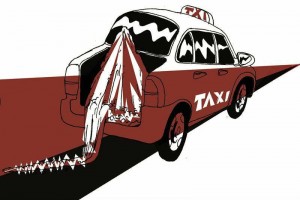
Each taxi driver earns between US$220 and US$367 every weekend for delivering drugs to restaurant managers, bar tenders, private security personnel, valet parking workers and street vendors who sell cocaine to students, youngsters, artists and musicians. (Photo: ILLUSTRATION EKO )
For years from five in the afternoon onwards a taxi driver has earned a small
fortune without transporting passengers.
He picks up his merchandise at Doctores neighborhood, near the bunker of
Mexico City's Attorney General's Office, pays between 20,000 pesos (1,470
dollars) and 40,000 pesos (2,940 dollars) for it, takes it home, keeps it in
small bags and hides them inside the spare tire of his Tsuru.
From Friday night to Sunday, he and four more drivers sell cocaine in Colonia
Condesa, one of the most cosmopolitan neighborhoods of Mexico City. When he is
asked to deliver cocaine at a bar, restaurant, nightclub or private party, he
parks in a dark street, opens the trunk and puts several wrappers in a bag of
chips or an empty soda can while pretending to repair his car.
"I move half kilo (1.1 pounds) [every weekend]. Others sell
less," says Mr. T with a conceited smile while sipping a beer at a bar on
Tamaulipas street.
Mr. T misses the "good times" of cocaine in the capital city,
in the 80's, when the Sinaloa Cartel controlled all drug sales. He says that
back then there was no minimal fee and that dispatchers like him were not
killed. They all worked for the same group, and if one of them could not sell
all the merchandise in one weekend, no one ended up dead in an alley.
He explains that in 2002 presumed members of the Gulf Cartel started
fighting for the market and that the Zetas joined the battle a couple of years
later. In 2010 a Gulf Cartel member killed his boss and his allies invited him
to switch sides.
He calculates that around 100 taxi drivers work for his new bosses in
Mexico City. Each driver earns between 3,000 pesos (220 dollars) and 5,000
pesos (367 dollars) every weekend for delivering "goods" to
restaurant managers, bar tenders, private security personnel, valet parking
workers and street vendors who sell cocaine to students, youngsters, artists and
musicians at Mexico City's hipster neighborhood to keep partying until dawn.
One gram costs 100 pesos (7.3 dollars), even though the price varies
depending on quality. In Santa Fe, for example, one gram costs between 400
pesos (29 dollars) and 600 pesos (44 dollars).
On November 13 Mexico's Lower Chamber approved 50 million pesos (3.6
million dollars) to compensate the families of the 43 missing students of
Ayotzinapa teachers training college who were allegedly handed over by local
police to a criminal gang (Guerreros Unidos, a splinter cell of the Beltrán Leyva cartel). This is the same amount that drug cartels earn with
cocaine business in Mexico City, according to estimates by the NGO Colectivo
por una Política Integral Hacia las Drogas (Collective for Comprehensive Drug
Policy - CUPIHD).
CUPIHD calculates that there are 85,000 users of illicit drugs such as
marijuana, cocaine, amphetamines, methamphetamines and other hallucinogens in
Mexico City.
Carlos Zamudio, a drug specialist and researcher, concurred that things have changed.
"You can find Sinaloa Cartel members in Morelos neighborhood
fighting for the area of Tepito with the Gulf Cartel. The bars of Condesa and
Roma are key for crime," he explained.
He added that La Famila Michoacana sells drugs in the east and south of
the city, in areas such as Iztapalapa and Tláhuac, while cells linked to Los
Zetas operate in the north of the city, near Cuautepec.
One June 9 a command executed six members of a family,
including two minors, in Cuautepec due to a drug dispute. Two kilos (4.4 pounds) of cocaine
were found inside the vehicle of one of the victims.
However, Mexico City government insists that cartels do not operate in
the capital city. Mexico City's Secretary of Government declined to be
interviewed for this story.


 SIGUENOS EN:



